Imagine stepping onto Lake Baikal on a crisp February morning when the thermometer plunges to -25°C, and the world around you transforms into a sheet of sapphire glass. Beneath your boots sits a metre-thick slab of the purest ice on Earth, revealing dark depths that drop more than a kilometre below. Sunlight streams through turquoise pressure ridges, while the frozen surface cracks and hums with a deep, resonant vibration — the natural voice of the planet's deepest lake shifting in its winter sleep.
For many international travellers, this is the moment they've dreamed about for years. And it's also the moment when a practical question appears: how do you actually move across this frozen world?
Search online forums, and you'll find two passionate camps. One insists you must book a Khivus hovercraft. The other swears by the legendary UAZ Bukhanka four-wheel-drive van. Each side argues with conviction. And each side is only half right.
A Word from Your Guide
"I've been guiding guests across frozen Baikal for years — in both vehicles, in every kind of winter. And I can tell you honestly: the question "which one is better?" is the wrong question.
The Khivus and the UAZ are not rivals. They are two different tools, each built for a different part of this lake. When I plan a winter route for our guests, I don't choose between them. I use both — because that's how you see the full picture of Olkhon.
My promise to every guest is simple: you will be warm, you will be safe, and you will see things that most travellers never see. The vehicle is just the means. The experience is what matters."
— Maxim, Senior Guide, Baikal Majestic
Two Legends of the Ice: How the Khivus and the UAZ Compare
For international travellers — no matter where they come from — both the amphibious hovercraft and the classic Russian off-road van feel like an adventure before the engine even starts. Each machine solves a specific geographical challenge on Olkhon Island and the surrounding Maloe More strait. Understanding their engineering helps you plan your days with confidence.
The Khivus Hovercraft: Siberia's Flying Carpet
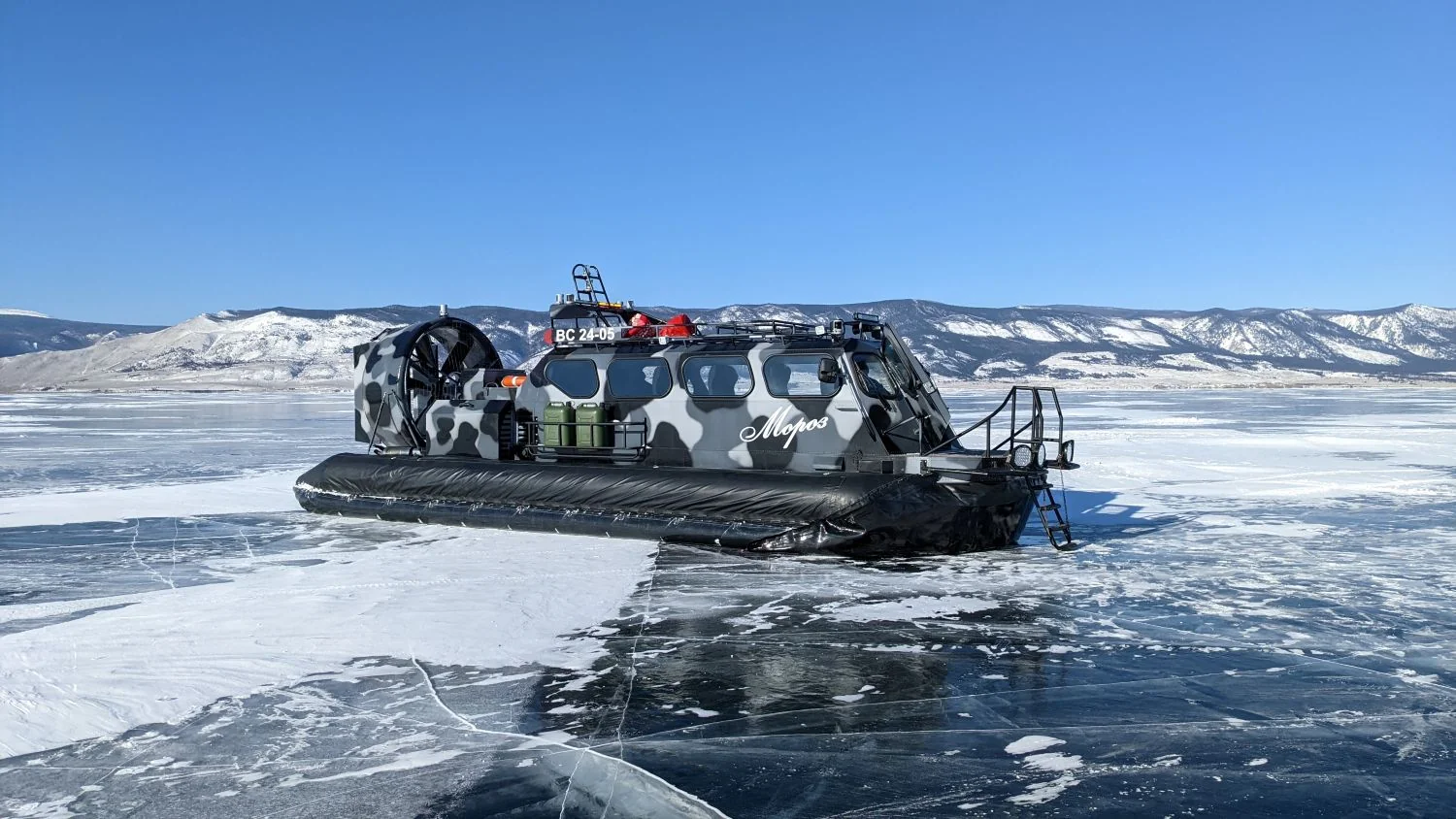
The Khivus is an amphibious air-cushion vehicle designed specifically for extreme northern climates. Rather than rolling on wheels, the craft inflates a flexible rubber skirt beneath its hull and glides smoothly a few centimetres above the surface. Because it skims on a cushion of air, it crosses glass-smooth black ice, deep snowdrifts, crushed ice fields, and even patches of open water with equal ease. Depending on the model and cabin layout, a Khivus seats between 6 and 18 guests in a heated, enclosed cabin equipped with soft armchairs, panoramic windows, USB charging ports, and dedicated space for camera bags.
The UAZ Bukhanka: The Legendary Siberian Workhorse
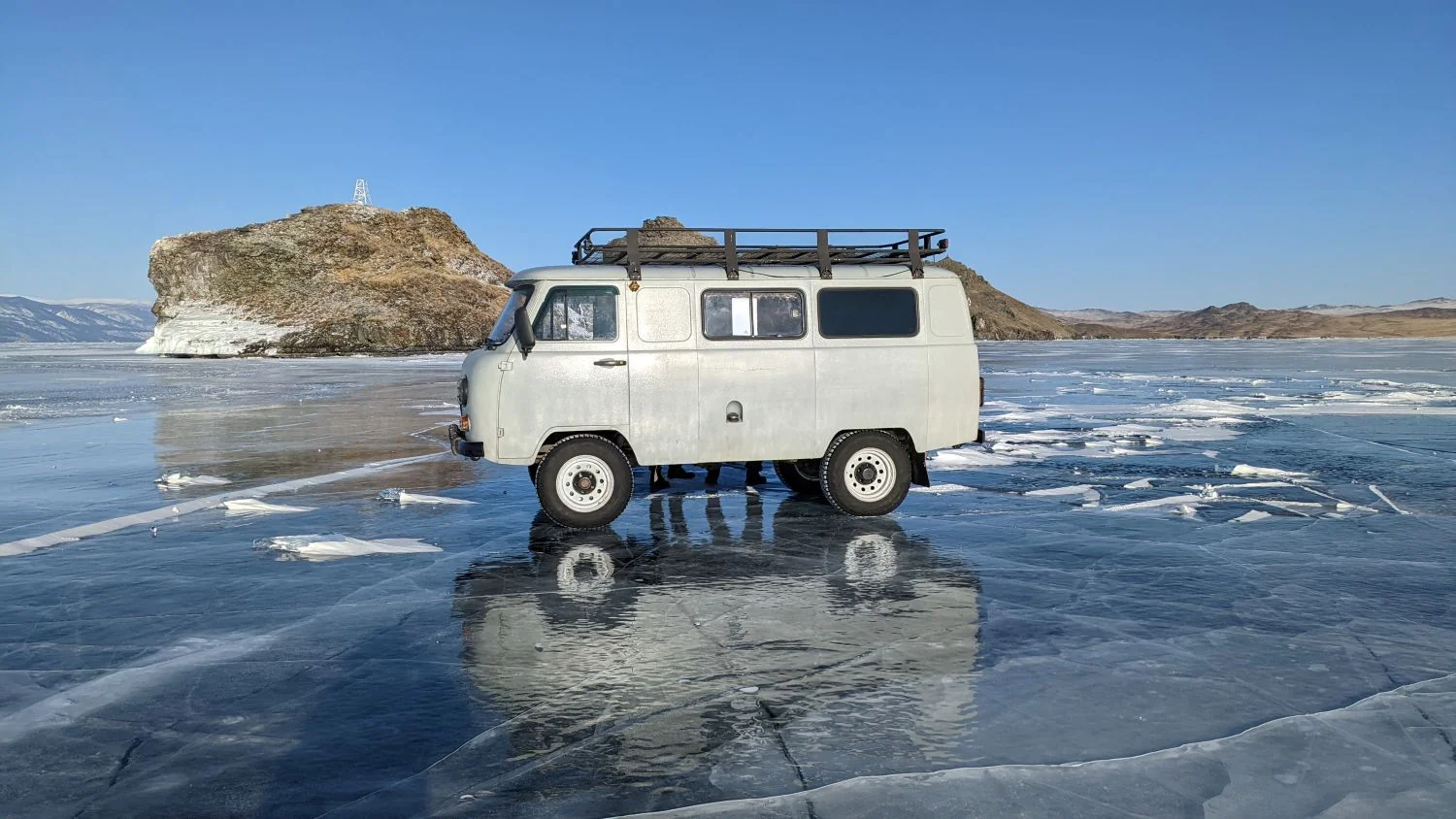
Affectionately nicknamed the Bukhanka (meaning "a loaf of bread" in Russian because of its rounded, retro silhouette), the UAZ-452 four-wheel-drive van anchors daily life across rural Siberia. For decades, this rugged machine has carried locals and explorers across Olkhon's roadless steppes, steep sandy valleys, and official winter ice roads. Seating up to 8 passengers, the UAZ pairs high ground clearance with mechanical simplicity and low-range four-wheel drive, climbing frozen dirt tracks where standard SUVs simply lose traction. Stepping into a custom-insulated Bukhanka gives you an authentic taste of overland Siberian travel.
Where Each Vehicle Shines Across Ice, Land, and Open Water
Comparing a hovercraft and a four-wheel-drive van by asking which one is superior misses the point of Baikal's geography. Each vehicle serves a distinct zone of responsibility across the lake and island.
"The Khivus and the UAZ work like two different tools in the hands of a master craftsman. With one you carve; with the other you plane the wood smooth. You cannot say one tool beats the other — everything depends on the task in front of you. Up north, where the ice shifts and the coastline turns vertical, the Khivus is the right choice. Down south, where you want to cross the steppe and climb high onto a panoramic headland, the UAZ takes over. We never force a choice between them; we use both."
When the Khivus Is the More Suitable Choice
Whenever your route follows the water's edge or ventures onto dynamic ice formations, the Khivus hovercraft proves its worth. Because its air cushion spreads the vehicle's weight evenly across a wide footprint, it exerts minimal pressure on the surface and leaves zero tyre marks on pristine, mirror-clear ice. That same amphibious design makes the Khivus the optimal choice for crossing thermal cracks, slushy leads, and areas where currents keep the ice thinner.
Northern Olkhon routes — especially the journey to Cape Khoboy, the dramatic northern tip of the island, and the sculptural ice grottoes of the Maloe More strait — suit the Khivus best. From lake level, the hovercraft brings you right up to icicle-draped sea caves and towering turquoise hummocks that remain invisible from the cliff tops above.
When the UAZ Is the Right Choice
Once your exploration shifts from the frozen water to the island's interior and southern coastline, the UAZ becomes your ideal companion. The southern part of Olkhon features calmer bays with stable official ice crossings, alongside a dramatic inland landscape of rolling steppes, sheltered valleys, and sweeping viewpoints. Here, the UAZ moves freely between frozen coves and high terrestrial ridges that an amphibious craft simply cannot climb.
Travelling overland in a UAZ also brings you face to face with Olkhon's living heritage. Unlike the eastern shore of the lake where Buddhism prevails, Olkhon Island serves as the spiritual heartland of shamanism — an ancient, living practice honouring the spirits of nature and the eternal blue sky. When your UAZ climbs toward coastal headlands or stops near sacred sites like Shamanka Rock, you will see wooden serge poles (carved wooden posts wrapped in ribbons, marking sacred boundaries). Local etiquette asks that you pause here with quiet respect. Never walk past the boundary posts onto restricted promontories, avoid climbing on sacred shamanic rocks, and never untie or touch the vibrant zalaa ribbons.
Quick Comparison: Khivus vs UAZ
Primary Surface:
Khivus: Smooth ice, pressure ridges, snow slush, open water leads.
UAZ: Island steppes, dirt tracks, steep hills, official southern ice roads.
Optimal Geography:
Khivus: Northern Olkhon, Cape Khoboy from the lake, ice grottoes.
UAZ: Southern Olkhon bays, inland valleys, high cliff viewpoints.
Cabin Capacity:
Khivus: 6 to 18 guests depending on model.
UAZ: Up to 8 passengers.
Cabin Temperature:
Khivus: +15°C to +20°C via autonomous heater.
UAZ: +18°C to +22°C with upgraded cabin heaters.
Ride Sensation:
Khivus: Smooth, gliding flight over the surface.
UAZ: Moderately bumpy, energetic overland Siberian drive.
Warmth, Comfort, and the Ride Itself
For most international visitors contemplating a Siberian winter holiday, the biggest source of anxiety is simple — freezing inside a vehicle hours away from the nearest town. Knowing exact cabin temperatures removes the guesswork before you pack your bags.
"Guests always ask me before the trip whether they will freeze out on the lake. I always tell them no. Inside the Khivus, you sit in warmth just like in a modern touring car. Inside our UAZ vans, you stay just as warm, only the character of the ride changes. You might feel every bump of a real Siberian track — and guests step out grinning because that rugged energy makes the adventure feel real."
Inside the Khivus: Warm Panoramic Lounge at Minus 30 Degrees
Step through the door of a Khivus when the morning air bites at -30°C, and you enter a sheltered cabin holding a steady +15°C to +20°C. Powerful autonomous diesel heaters and multi-layer cabin insulation keep the cold outside where it belongs. You can unzip your heavy down parka, rest your camera on the shelf beside your armchair, plug your phone into a USB port, and watch frozen cliffs unfold outside the wide panoramic windows without ever putting on your mittens.
Inside the UAZ: A True Siberian Drive With Real Heat
Standard factory UAZ vans built for summer farm work can feel draughty, which is why tour preparation matters. A properly winterised UAZ Bukhanka lined with thermal insulation and fitted with auxiliary heaters maintains a cosy +18°C to +22°C throughout the cabin. Yes, the leaf-spring suspension bounces over frozen ruts and steppe tracks — if you have a sensitive lower back, bringing a small travel cushion adds welcome support — yet for most travellers, that unmistakable mechanical rhythm becomes a favourite memory of Olkhon.
How Smooth Flight Compares With a Classic Siberian Drive
The contrast between the two vehicles comes down to sensation. The Khivus delivers the dreamy feeling of skimming effortlessly above a frozen sea, banking gently into turns like an aircraft on glass. The UAZ grounds you in the tactile reality of the island, climbing dusty ochre slopes and crunching through snowdrifts.
Lunch on the Ice: The Siberian Ritual You Will Always Remember
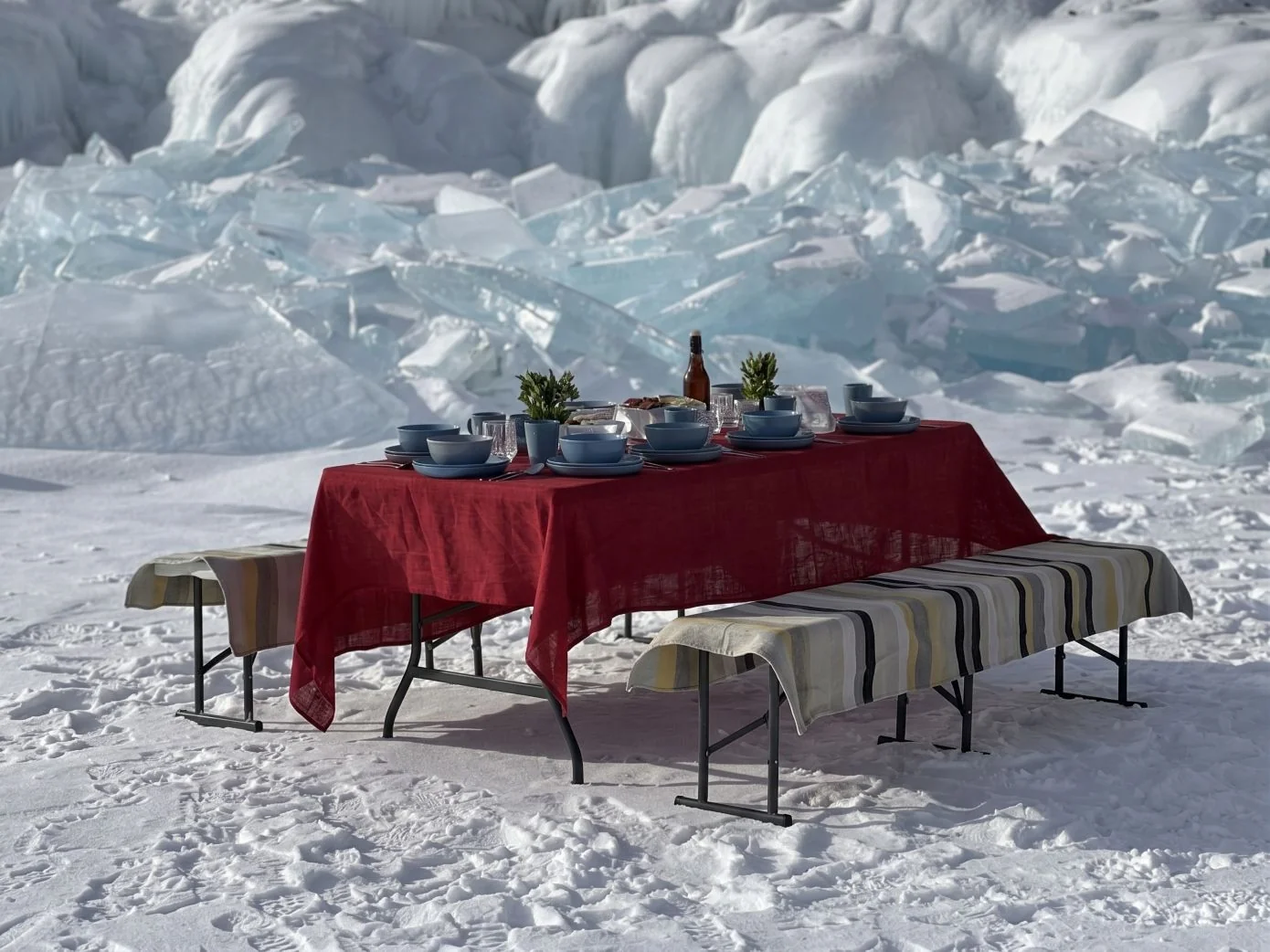
Midday on Lake Baikal brings an experience that no restaurant on dry land can replicate. Far from shore, surrounded by kilometres of blue ice, your vehicle pulls up beside a sheltered wall of glittering hummocks for a traditional outdoor feast. The lunch format depends on the day's route: on a UAZ day, the driver and guide cook ukha right on the ice; on a Khivus day, lunch is delivered in thermal containers. In either case, it is a full hot meal in the open air.
Omul Fish Soup Cooked Right There on the Ice
On a UAZ route day, lunch becomes part of the adventure. While you stroll across the crystal surface and photograph geometric ice fractures, your driver and guide set up a portable gas burner or safe fire pit right on the lake to simmer fresh ukha — a rich, aromatic soup made from Baikal omul, a whitefish endemic to these cold waters, cooked with potatoes, onions, and bay leaf.
Warmth and Serving: So Nobody Freezes at the Table
Dining outdoors at -20°C stays surprisingly comfortable when organised with care. Large thermoses pour endless cups of steaming herbal tea infused with wild Baikal herbs, while the rich, hot fish soup — or the hot meal from thermal containers on a Khivus day — warms you from the inside. Your meal unfolds on rustic wooden tableware accompanied by thick slices of fresh bread, local pickles, and savoury Siberian snacks.
When your itinerary also includes village stops on land, you will meet another local staple — steaming buuzy (Buryat pleated meat dumplings). To eat them like a local, pick one up with your fingers, bite a small hole, drink the broth first, and then savour the spiced meat inside. The entire ice picnic lasts 40 to 60 minutes.
The Moment Baikal Becomes Part of You
"Cooking ukha on the ice is far more than lunch; it is a Siberian ritual. While guests wander across the transparent ice, take photographs, and breathe the crisp frost, the driver quietly prepares the soup. Nobody rushes anyone else. Then everyone gathers around the table, wraps their hands around hot wooden bowls, and looks down through three feet of crystal water beneath their boots. Right in that moment, Baikal stops being a dot on a map and becomes part of who you are."
The Combo Experience: Why the Best Winter Tour Uses Both Vehicles
Once you understand how the hovercraft and the four-wheel-drive van complement one another, the logic behind a combined itinerary becomes crystal clear.
"A combo tour is never two separate excursions bolted together for the price of one. It gives you two distinct perspectives on Lake Baikal. From the water in a Khivus, you feel the lake's raw power and scale. From the high ground in a UAZ, you take in its boundless horizons. Without one of them, your picture of winter Baikal remains unfinished, which is why we tell our guests to experience both."
Seeing the Full Picture: Ice From the Water, Land From the Ground
Dedicating one full day to the Khivus hovercraft lets you glide effortlessly to the northern reaches of Olkhon Island, marvel at the towering rock pillars of Cape Khoboy from water level, and peer inside frost-lined ice grottoes. Spending your next day aboard a prepared UAZ Bukhanka opens up the southern half of the island — climbing to panoramic cliff edges, crossing golden steppes, and visiting secluded coves.
Smart Logistics: Using the Right Vehicle for Each Part of Olkhon
Coordinating seasonal ice crossings from Irkutsk, matching hovercraft charters with island road transport, and finding reliable winter accommodation on Olkhon can feel overwhelming when you plan from abroad. Baikal Majestic solves this logistical puzzle by combining Khivus hovercraft access, prepared UAZ overland days, and overnight stays in premium lakeside lodges into one seamless four-day route.
What You Pay For in a Combo Route Versus a Single-Vehicle Tour
Looking transparently at expedition budgets helps you choose wisely. Operating a Khivus hovercraft requires specialised marine licensing, aviation-grade maintenance, and higher fuel consumption, which naturally places hovercraft days in a higher price bracket. The UAZ Bukhanka costs far less to run, offering a rugged, budget-friendly way to see the island. When you book a four-day combo tour, you invest in seamless logistics and complete geographical coverage rather than compromise.
What Might Surprise You (and Why It's Fine)
Even well-travelled adventurers encounter a few sensory surprises during their first day on frozen Lake Baikal. Knowing what to expect turns potential confusion into pure enjoyment.
- The ice speaks loudly in winter. As daytime sun warms the surface and night frosts contract it, the metre-thick ice sheet cracks, booms, and groans beneath your feet. That deep acoustic rumble signals a healthy, living sheet of solid ice adjusting its tension.
- The UAZ bounces on island tracks. Riding a Bukhanka across frozen steppe ruts involves real off-road motion. If you have a sensitive back, pack a small inflatable pillow or ask your guide for a middle-row seat.
- Inside and outside belong to different climate zones. Stepping from a +20°C cabin onto -25°C ice creates an instant 45-degree temperature swing. Dress in breathable layers so you can peel off your outer jacket the moment you climb back aboard.
- The cold is dry, not damp. Siberian winter air holds very little moisture. -20°C here often feels less biting than -5°C in a coastal city. Most guests are surprised by how comfortable they feel once they dress properly.
When This Tour Is Not for You (Honest Advice)
We believe in matching every guest with the right style of travel rather than selling a single package to everyone.
If you experience chronic back pain or dislike off-road jolts, skip the UAZ overland days and choose a Khivus-only itinerary that glides smoothly from start to finish.
If you are travelling on a tight budget, the four-day combo route may stretch your wallet. Opting for a two-day UAZ winter tour or a three-day UAZ winter tour will still put you right on Baikal's famous transparent ice without overspending.
Frequently Asked Questions
Can I take photographs from inside the Khivus?
Yes. The Khivus has large panoramic windows designed specifically for photography. You can shoot from inside without stepping into the cold, and your guide will stop at the most photogenic locations for you to step out onto the ice.
What happens if I feel motion sick in the UAZ?
The UAZ does bounce on unpaved tracks. If you're prone to motion sickness, tell your guide in advance. They'll seat you in the middle row, where the ride is smoothest, and can adjust the pace.
Is the ice safe to walk on?
Yes, when you're with a professional guide. Our team monitors official ice reports daily and follows certified routes. You'll receive a full safety briefing before stepping onto the ice, and we carry all necessary rescue equipment. Read our full safety guide.
What should I wear for a day on the ice?
Three layers: thermal base layer (merino wool or synthetic), fleece mid-layer, and windproof down parka. Insulated boots, mittens, and a warm hat are essential. We send every guest a detailed packing list before departure. See our Ultimate Winter Packing List.
Can children join a winter Khivus or UAZ tour?
Yes, children can join. We provide child car seats for the UAZ and can adapt the itinerary for families. Let us know in advance so we can prepare.
How long does the ice picnic last?
Typically 40 to 60 minutes. This gives you enough time to warm up from the inside, enjoy the meal, and take photographs before the afternoon chill sets in.
What if the ice road isn't open yet?
This is a common situation in early winter. If the official ice road isn't open, we use the Khivus hovercraft to cross safely. You'll still reach Olkhon — just by a different, equally spectacular route.
Choosing Your Ideal Winter Route on Lake Baikal
Ultimately, the Khivus hovercraft and the UAZ Bukhanka never compete against one another — they complete one another. Where the Khivus skims effortlessly over northern ice fields and brings you nose-to-nose with frozen grottoes from the water, the UAZ climbs Olkhon's golden steppes and reveals sweeping vistas from high above the lake.
Your choice comes down to your schedule, comfort preferences, and curiosity:
- Two-day UAZ tour — a quick, budget-conscious introduction to Olkhon's southern bays, Cape Khoboy, and the famous ice grottoes.
- Three-day UAZ tour — more time to explore, with visits to Shamanka Rock, Cape Khoboy, and the chance to try ice skating on the frozen lake.
- Dedicated Khivus route — effortless, glass-smooth gliding across the lake with zero off-road bumps.
- Four-day Olkhon winter tour — the most complete itinerary. Explore the north and south of Olkhon by UAZ, with an optional Khivus day upgrade for the northern ice route when conditions require or when you want extra comfort. Contact us for details.
Your Winter Baikal Story Begins Here
Whenever you are ready to turn daydreams of transparent blue ice into a real Siberian journey, reach out to our local team with your preferred travel dates. We will help you match your schedule and comfort style with a winter route across Lake Baikal that you will treasure for a lifetime.
Have questions about the ice, the vehicles, or the route? Write to us — we'll give you a straight answer, whether you book with us or not.