Standing on Lake Baikal's winter ice, you look down through a metre of transparent glass into a dark, seemingly bottomless world. Directly beneath your boots, silver columns of frozen methane bubbles hang suspended in the ice like coins in a vault. Ahead, where the ice sheet meets the rust-red marble of Olkhon Island, a cavern glows with an intense sapphire light. When you duck beneath the curtain of metre-long icicles at the threshold, the wind vanishes — replaced by the quiet resonance of a winter cathedral that no human hand designed.
Nature rebuilds this cathedral from scratch every year. Each November, before the surface of the lake locks shut, Siberian storms hurl freezing spray against Olkhon's headlands. Layer by layer, the spray freezes against the rock, carving arches, pillars, and crystal chandeliers. The grotto you step into this February did not exist twelve months ago; by May, it will have melted back into the waters of one of the world's oldest and deepest lakes.
This guide is an insider's map to the ice grottoes and bubble fields of Olkhon Island: where they form, when to see them at their best, how to move across the ice safely, and what local etiquette asks of you.
Where do the ice caves of Olkhon form?
Olkhon stretches for 71 kilometres along Baikal's western shore, creating a sheltered strait between the island and the mainland known as the Maloye More (Small Sea). Because autumn winds strike each headland from a slightly different angle, the caves vary dramatically — from intimate tunnels in the Maloye More to cathedral-sized vaults on the open-water side of the island.
Four locations consistently offer the most dramatic grottoes every winter:
| Location | Setting | Signature formations | Best light |
|---|---|---|---|
| Cape Khoboy | The northernmost tip, where the Maloye More meets Big Baikal | Towering turquoise vaults, massive frozen wave splashes on pink marble | Sunrise — warm alpenglow on the eastern face |
| Cape Kharantsy | Sheltered western coast, north of Khuzhir | Accessible tunnels, twin-arched caverns, intricate icicle ceilings | Late afternoon / sunset — golden rays pierce the arches |
| Ogoy Island | Granite islet in the centre of the strait | Wind-sculpted caves, dense white ice draperies below the Buddhist stupa | Early morning or late afternoon — soft directional shadows |
| Kobylya Golova | Southern entrance to the Maloye More | Wild, less-visited corridors and thick, layered ice waves | Mid-morning through sunset |
At Cape Khoboy — whose name translates from Buryat as "Fang" after its sharp vertical spire — the open fetch of Big Baikal generates enormous November waves. Those waves crash high against the marble face, creating deep blue caverns large enough for a dozen people to walk through upright. Closer to Khuzhir, Cape Kharantsy offers smaller, more intimate caves where sunset light reaches the back wall. Further south, Ogoy and Kobylya Golova showcase wild coastal ice tunnels where the wind twists frozen spray into swirling white columns.
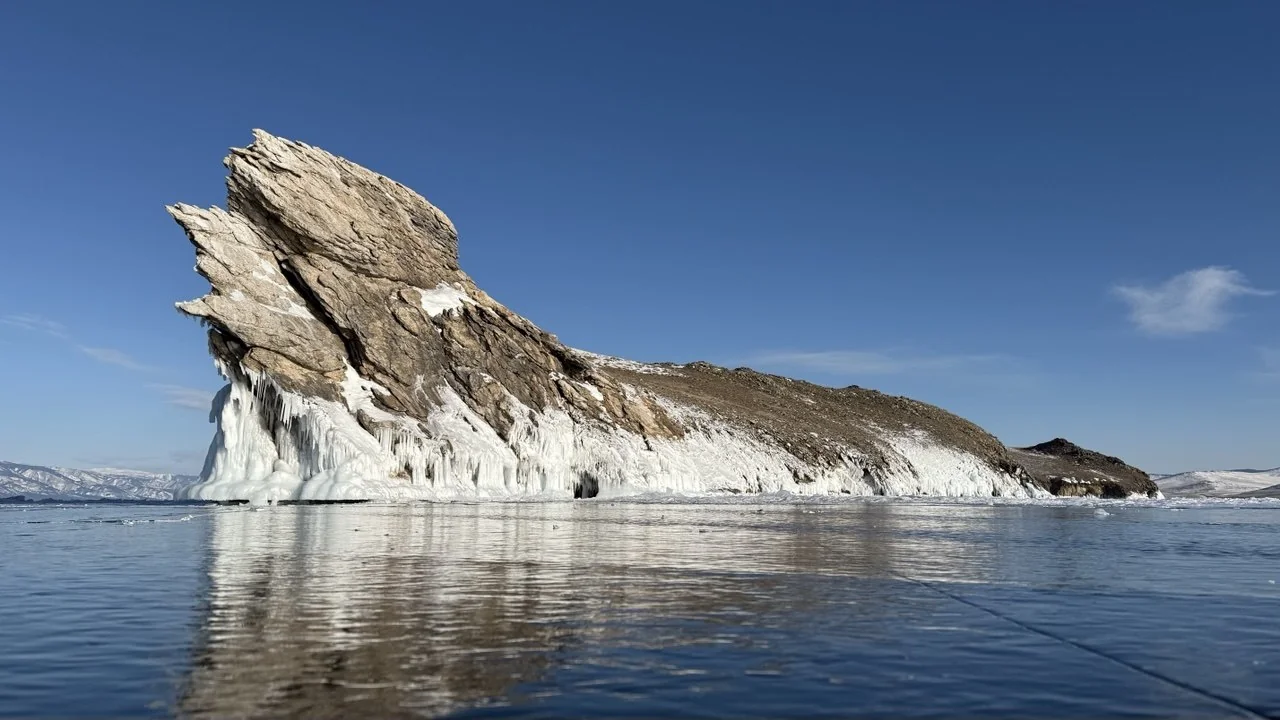
Why the architecture changes every winter
If you compare photographs of the same cave across three consecutive winters, the entrance, the icicles, and the vaults will never match. A season preceded by weeks of north-westerly storms creates colossal, thick-walled grottoes and three-metre icicles around Khoboy and Kobylya Golova. A calmer autumn creates cleaner surface ice and delicate, lace-like ceilings in the sheltered bays of the Maloye More. Because the lake rewrites its blueprint every November, relying on fixed GPS pins from old blogs often means arriving at bare rock while a pristine cavern hides around the next headland.
When is the best time to see the ice caves — and how do you photograph them?
The short answer: mid-January through mid-March is the most reliable window for cave structure, ice transparency, and manageable temperatures. For photography, the two hours after sunrise and the two hours before sunset turn the caves from dark hollows into glowing lanterns.
The longer answer. Baikal stores an immense volume of thermal energy, so it freezes much later than the surrounding rivers. The Maloye More usually locks over in the second half of January; the open lake follows. From late January to early February, the fresh ice sheet settles in its purest, darkest state, free of heavy snow, reaching a thickness of roughly 60–80 centimetres. By mid-February and early March, the ice grows to a metre or more, the caves reach their fullest architectural depth, and daytime temperatures range from −8°C to −15°C. By late March, daytime thaw begins softening the outer icicle curtains.
Light is the difference between a snapshot and an image. Just after sunrise and just before sunset, low-angle rays strike the ice draperies horizontally, penetrating deep through the translucent walls until every icicle radiates warm amber and electric blue light. At midday, the sun climbs high, casting harsh shadows inside the cave mouth and flattening the blue tones of the surface ice.
For dedicated photographers, a 6 a.m. start to reach Khoboy before dawn rewards with pink alpenglow on the marble and empty caverns before the day groups arrive. But a winter holiday should not become an endurance test. Most guests are happiest visiting tucked-away grottoes in the late morning or late afternoon, when the sun still angles brightly through the icicles. If you are travelling specifically as a landscape photographer chasing dawn reflections, a bespoke route can position you inside the finest caves at first and last light while a warm vehicle waits nearby.
Practical photography tips for sub-zero caves
- Pack an ultra-wide lens (14–24mm). It lets you stand inside a shallow grotto and frame the jagged ceiling against the glowing ice sheet outside.
- Keep spare batteries against your body. Lithium cells lose voltage rapidly at −20°C; carry two spares in an inner pocket and swap them as soon as the primary indicator drops.
- Wear thin liner gloves under windproof mittens. Try not to touch metal tripod legs or camera dials with bare skin in the wind.
- Shoot low to capture depth. Place the camera centimetres above the cleared ice outside the entrance to highlight the geometric white fractures running through the dark blue slab.
- Seal your camera before returning to warmth. Condensation forms instantly on cold glass in a heated cabin or hotel. Bag the camera outside, then let it warm gradually for 20–30 minutes.
How safe are the ice caves — and how do the rules change?
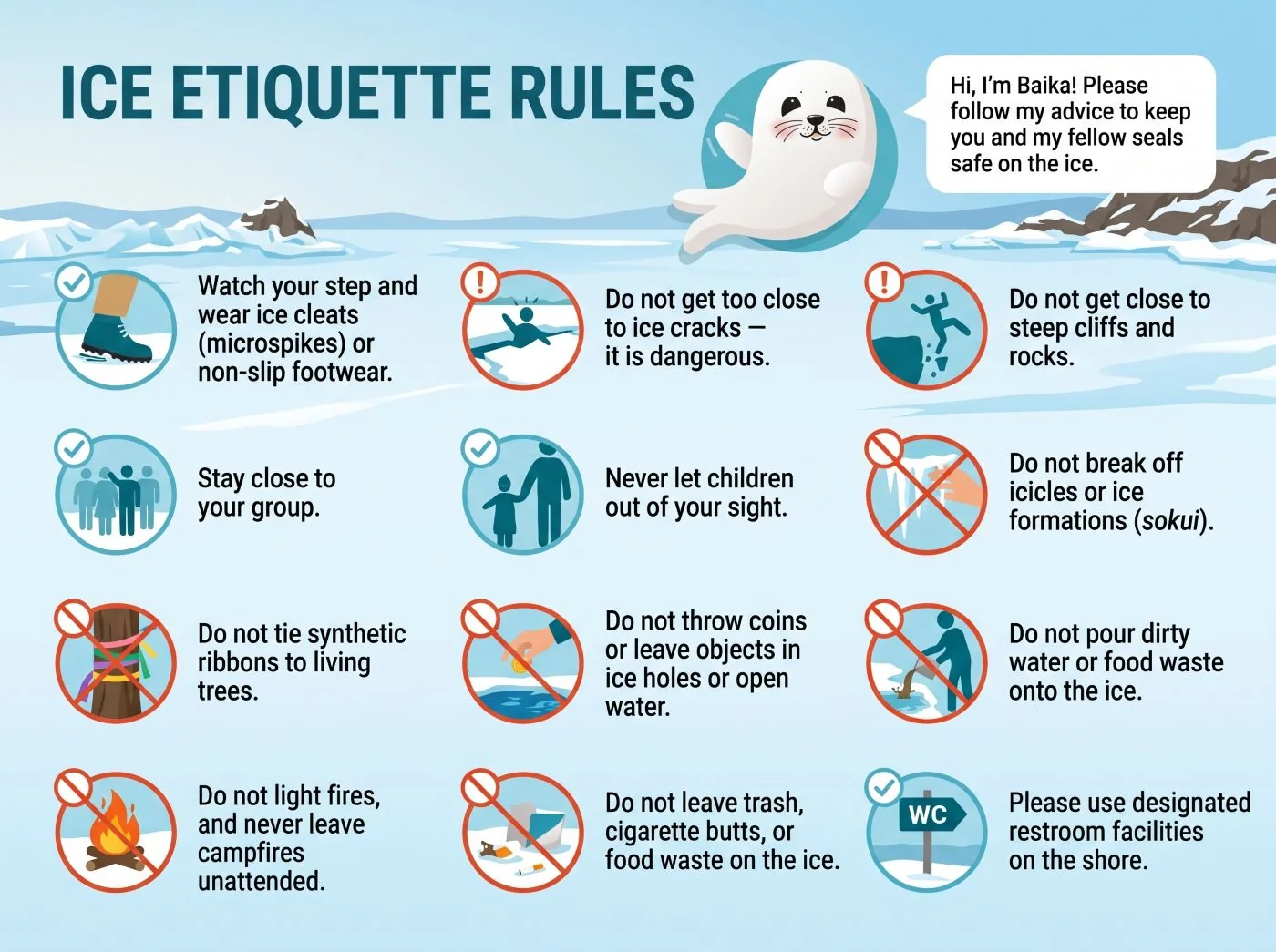
The short answer: the caves themselves are stable once inspected, but the ice, coastal cracks, and official access rules change from season to season. Every responsible trip begins with a check of current ice conditions and active regulations — not with last year's map.
What the caves demand. By February, the solid ice sheet easily supports multi-tonne vehicles, and the sharp booming cracks you hear are thermal expansion: the slab adjusting to daytime sun, not a sign of failure. Inside the grottoes, however, you step into unmanicured nature. The floor polishes to a mirror finish before freezing solid; and narrow tide cracks sometimes mark the boundary where floating ice meets stationary rock.
The human factor. For many international travellers, the real barrier is uncertainty: personal safety on the ice, navigation in a foreign language, and whether remote island lodging can keep out a −25°C night. Those concerns are legitimate. They are also solvable — but only with a guide who reads the ice daily, not with a rental car and a downloaded map.
The rules are not static — and that is normal. Ice conditions on Baikal take shape differently every year: the opening dates of official crossings, the permitted sections, and vehicle requirements shift depending on ice thickness, winds, and decisions by the relevant authorities. That is why we do not publish a "forever" itinerary or promise a specific date for driving onto the ice in a specific place. Instead, every winter route is built on three constant checks: the current EMERCOM/GIMS bulletin, a physical inspection of the entrance and overhanging ice, and a clear plan to change the route if conditions have shifted since the morning report. We track changes as they come in and shape each day so that it is both spectacular and sound — sometimes that means choosing a different bay or a different vehicle, and that is part of normal work on living ice.
That is exactly why a guide travels beside you on tour — a person who knows which grottoes are worth seeing today and which route to take to reach them safely. He is always nearby: ready to tell you where to turn, what to photograph, and how to spend your time so that the impressions stay vivid and memorable.
For a broader winter travel checklist for Baikal — gear, insurance, emergency protocols — see our Is it safe to travel to Lake Baikal? guide.
What are the frozen methane bubbles — and can you light them?
The short answer: the silver "coins" beneath your feet are methane bubbles caught layer by layer as the ice thickened. They are beautiful, safe to photograph, and not meant to be ignited: safe combustion requires a rare combination of gas volume and ice depth, and chasing a flame is a less memorable experience than photographing these columns or drinking Baikal water from a fresh hole.
The physics in plain language. Throughout the year, organic deposits on the lake floor decompose and release small streams of methane. In summer, the gas simply escapes into the air. Once winter seals the lake with a transparent ice lid, rising gas hits the underside of the ice and flattens into a silvery disc. Because cold nights thicken the ice downward, each new bubble from the same fissure freezes a fraction lower than the last. The result is a tall vertical stack of white coins suspended in dark, transparent glass.
Where to find the best fields. The sheltered coves of the Maloye More, the shallow bays near Khuzhir, and the southern shores of Olkhon produce the densest concentrations — but autumn wind and snow cover shift the clearest fields to new bays every year. Drifting snow can blanket a patch overnight while strong wind sweeps another cove clean by dawn. Local guides scout the bays daily and know the best locations for photographs.
Why we choose cameras over matches. Visitors often ask whether you can drill a hole into a frozen bubble and ignite the escaping gas. Igniting methane can produce a dramatic flash on video, but it is neither a reliable nor a particularly safe spectacle: conditions align rarely, and the flame lasts seconds. A far more memorable way to connect with the lake is to photograph untouched pearl stacks in the morning sun and to watch your guide drill a fresh hole into clean, bubble-free ice so you can drink the purest natural freshwater on Earth straight from Baikal.
What is "ice etiquette" on Olkhon — and why does it matter?
The short answer: every curtain of icicles and column of sokui inside an Olkhon grotto grew over weeks from November spray. Once winter locks the lake, no new waves can repair a broken chandelier until the following year. Ice etiquette is not restriction for its own sake; it is a way to leave the gallery untouched for the next traveller.
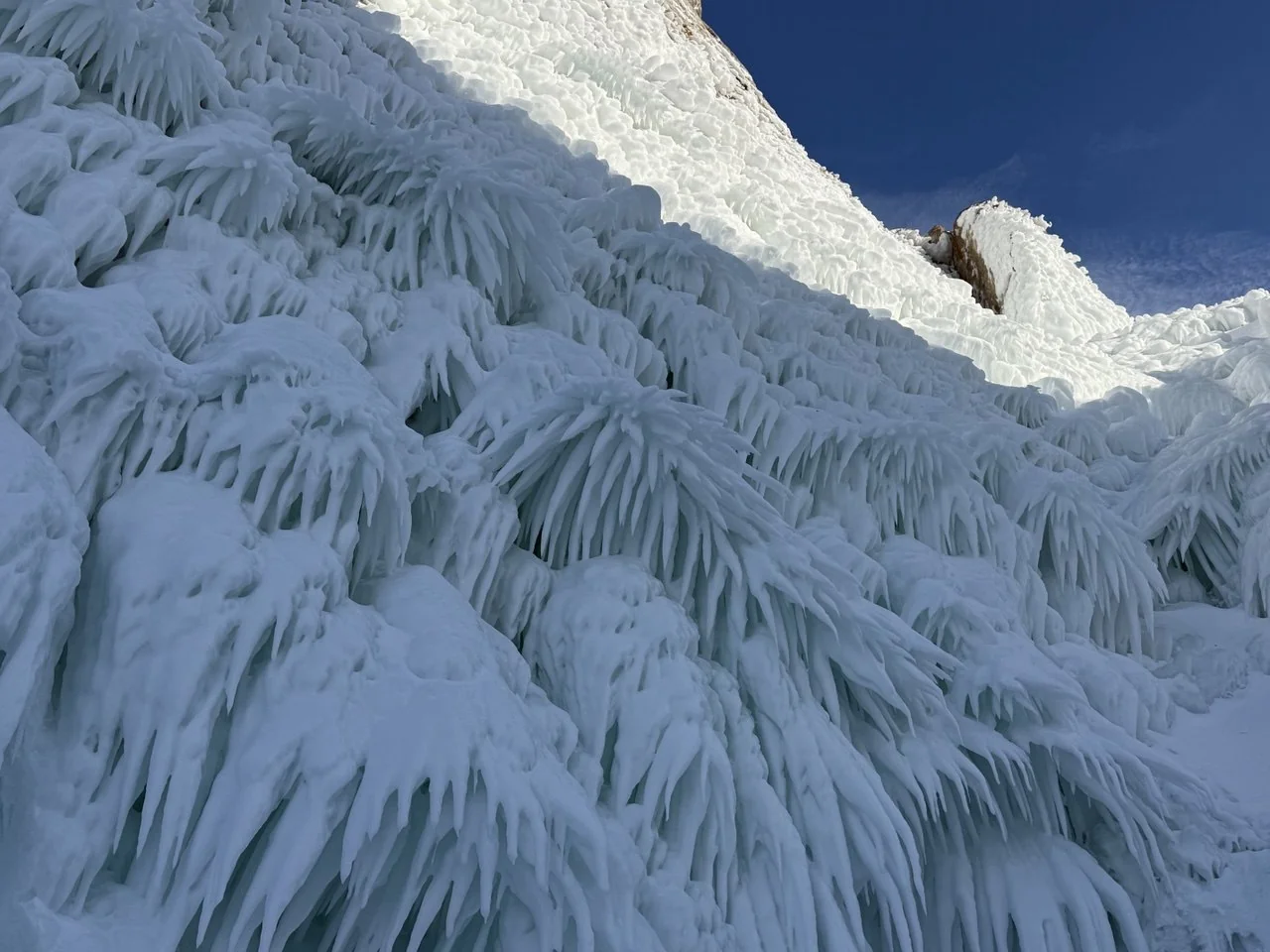
The practical rules are simple:
- Do not break off icicles as souvenirs. Nature carved them over months.
- Do not strike heavy ice formations for echoes or carve initials into grotto walls.
- Take only photographs; leave only clean tracks.
- At sacred sites — Shamanka Rock, the serge poles, the Stupa on Ogoy — walk quietly, do not untie the zalaa ribbons, do not climb on ritual stone cairns, and do not enter the through-cave inside Shamanka Rock, where only initiated shamans step.
- If your route crosses to Ogoy, walk clockwise around the white Stupa of Enlightenment, keeping a calm, mindful presence.
The cultural context behind these rules deserves its own article; here, the operative principle is one — respect. Olkhon is not a theme park. It is, at the same time, a living spiritual landscape and a fragile seasonal ecosystem.
How do you plan a winter journey to the ice caves?
Standing beneath a glowing blue ceiling of metre-long icicles while silver bubbles stretch beneath your feet and golden afternoon light glides across the Maloye More is an impression no photograph can fully capture. You have to hear the deep acoustic hum of the ice sheet and see the turquoise glow of the grottoes with your own eyes to understand why winter on Baikal feels like stepping onto another planet.
The logistics, however, are real: the lake freezes differently every year, the rules shift, and the most beautiful caves are not marked on a fixed map. That is exactly why a local team first builds you a clear itinerary — with waypoints, timing, and a plan for the day — and then keeps a finger on the pulse: checking the morning bulletin, inspecting the entrance, and adjusting if conditions have changed. You get both the certainty of a plan and the flexibility of living ice — and the impressions stay vivid and memorable.
If you want to see the caves at your own unhurried pace on our classic four-day Olkhon winter programme, or design a custom private photography expedition timed to golden-hour light, write to us. Baikal has waited 25 million years; the spring sun will eventually melt this season's cathedrals, but November will build them again. Your window is now.